AquaVentus Site Study Zone 4 & 5 German EEZ North Sea
Offshore H2 Suitability Ranking for Wind Energy Areas
Background and Objectives
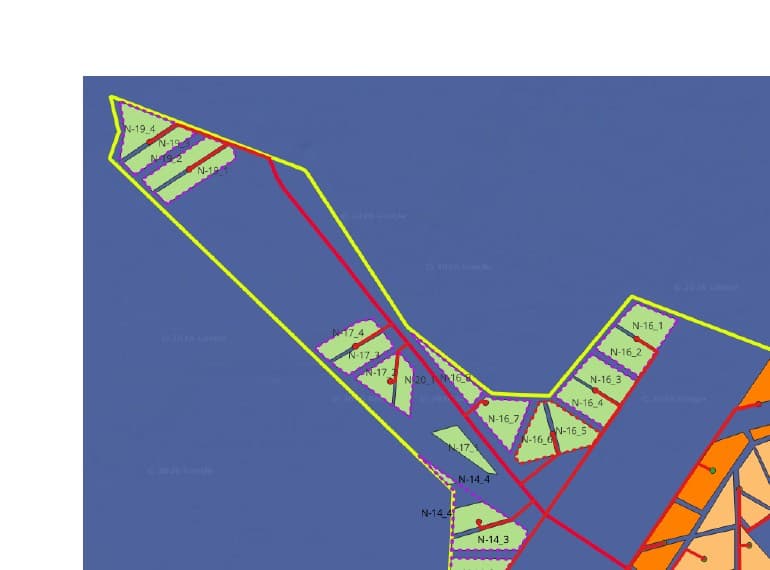
The 2025 Site Development Plan (FEP 2025, BSH) established the areas N-14, N-16, N-17, N-19 and N-20 — the first wind energy areas west of the SN10 shipping lane in the German Exclusive Economic Zone (EEZ) of the North Sea. These areas cover approximately 2,700 km² with a capacity potential of up to 30.9 GW.
In parallel, the 2037/2045 Grid Development Plan (NEP 2025, second draft) found that offshore electrolysis could not be included in grid planning due to the lack of a statutory mandate and regulatory framework. This creates a double regulatory gap for Zone 4 and 5: neither a temporal sequencing in the FEP nor consideration of the offshore H2 option in the NEP.
Against this background, this study examines which of the areas in Zones 4 and 5 are particularly suitable for offshore hydrogen production. The assessment is based on technical, economic and spatial planning criteria, resulting in a ranking of the areas and regulatory conclusions.
Scope of Investigation
The study covers potential individual areas in the N-14, N-16, N-17, N-19 and N-20 zones of the German North Sea EEZ. The investigation area comprises up to 21 individual areas with a total area of approximately 2,700 km² and a capacity potential of up to 30.9 GW of wind energy.
The commissioning horizon of the studied areas corresponds to the NEP target year 2045 and the FEP development path 2035–2045. The study does not examine structural exclusion criteria such as nature conservation requirements, as all areas listed in the FEP are fundamentally considered suitable for offshore hydrogen use.
Five Assessment Criteria
The suitability assessment is carried out using a multi-criteria decision analysis (MCDA). Each individual area is assessed against the same criteria and assigned a normalised score from 1 to 5 points per criterion.
Systemic Benefit — Curtailed Energy (Weighting: 25%)
Share of curtailed energy quantities in relation to potential annual total production, based on expansion scenario 25 in percent. Areas with high projected curtailment benefit most from integrating hydrogen production.
Systemic Benefit — Wind Energy Yield (Weighting: 30%)
Equivalent full-load hours based on expansion scenario 25 in hours per year. High full-load hours directly affect plant utilisation and specific levelised costs of energy.
Proximity to Planned H2 Transport Infrastructure — AquaDuctus (Weighting: 35%)
Distance to the nearest H2-suitable pipeline corridor (AquaDuctus) in kilometres. Highest weighting, as proximity to the planned H2 transport infrastructure has a significant influence on connection costs, realisation risks and integration into an overarching offshore hydrogen system.
Distance to Service Infrastructure (Weighting: 5%)
Distance to the nearest infrastructure port via common shipping routes (Esbjerg, Wilhelmshaven) in kilometres. Shorter distances reduce travel times and increase the operational availability of personnel and spare parts.
Water Depth and Foundation Costs (Weighting: 5%)
The water depth of the different areas and its influence on the foundation of the platforms. Increasing water depth raises requirements for foundation, installation and operation of offshore infrastructure.
Assessment and Ranking
The results show clear differences in the relative suitability of the studied areas for offshore hydrogen production. The most decisive factors are the highly weighted criteria: proximity to AquaDuctus and wind energy yields. Areas with high scores in both criteria achieve the best overall ratings.
The N-19 zone areas show the highest suitability. N-19.1 and N-19.2 achieve the highest overall scores at 4.4 points each, followed by N-19.3 and N-19.4 at 4.0 points each. The decisive factors are the very high systemic benefit values (criteria 1 and 2). The N-19 areas combine high expected wind energy yields with a high potential for utilising otherwise curtailed energy quantities, representing the greatest systemic and energy-economic added value within the studied area collective.
Medium suitability is shown particularly by N-14.3 to N-14.4, N-16.5 to N-16.8 and N-17.2 to N-17.4. The reference area SEN-1 achieves the lowest overall score at 2.5 points — while it has a short pipeline connection, it only achieves the lowest scores in the highly weighted criteria. The ranking shows that a hydrogen connection alone is not sufficient; what is decisive is the combination of systemic benefit, high available wind energy and AquaDuctus connectivity.
Conclusions and Regulatory Implications
The study shows that the investigated areas in Zones 4 and 5 of the German North Sea EEZ exhibit different suitability potentials for centralised offshore hydrogen production. The results provide the technical indication that the best-rated areas should be considered early in future FEP and NEP processes with regard to potential offshore hydrogen use.
For future planning and consultation processes, the results provide technical guidance on which areas could be examined more closely for potential hydrogen-related use. In addition to the best-rated N-19 areas, interactions with offshore wind expansion targets, grid connection, spatial planning, environmental concerns, shipping, military use and the development of H2 transport infrastructure should be transparently considered.
The study does not replace a technical feasibility study, detailed planning of an electrolysis platform or economic analysis of a specific project. Its aim is the relative comparison of selected areas and the derivation of guidance for future FEP and NEP processes.
Download the full study as PDF